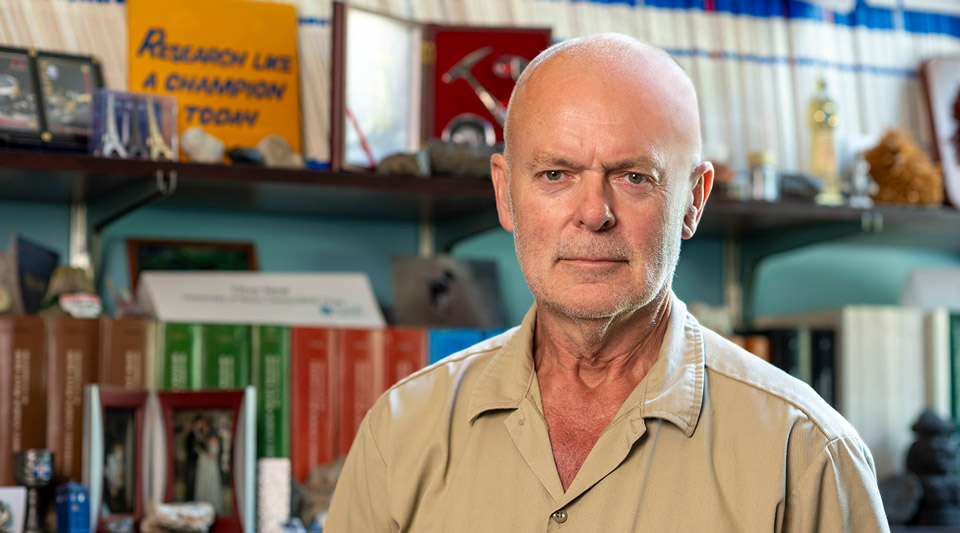
Clive R. Neal, professor of civil and environmental engineering and earth sciences at the University of Notre Dame, has been named the winner of the 2026 Waldo E. Smith Award by the American Geophysical Union (AGU).
Named after Waldo E. Smith—a specialist in hydrology and civil engineering who served as AGU’s first executive secretary and director for 26 years—the biennial union award recognizes a senior scientist for extraordinary service to Earth and space science. Winners are recognized for having strengthened and helped advance their scientific disciplines, playing unique leadership roles in scientific associations, education, legislation, research, management, philanthropy, or the public understanding of science.
Neal is a traditionally trained geologist who was educated in the United Kingdom before moving to the United States in 1986, where he started his love of the Moon through the analysis of Apollo samples as part of a postdoctoral fellowship at the University of Tennessee, Knoxville. He moved to Notre Dame in 1990 and initially focused his research on the origin and evolution of the Moon and its “supervolcanoes,” and expanded his analytical approach to include geophysics. During his time at the university, he has expanded his research to the accessibility and use of lunar resources with the aim of supporting a permanent human presence on the Moon that will also benefit society here on Earth.
Neal’s leadership as a two-time chair of NASA’s Lunar Exploration Analysis Group (LEAG) resulted in the “U.S. Lunar Exploration Roadmap”—the blueprint guiding America’s return to the Moon and the foundational document for the current United States space policy. His creation of the LEAG Commercial Advisory Board effectively bridged the gap between government space programs, academia, and the private aerospace sector, achievements that previously earned him the NASA Wargo Award in 2015 and NASA’s 2026 Shoemaker Distinguished Scientist Medal.
As the co-chief editor of “New Views of the Moon 1 and 2” and author of over 150 peer-reviewed articles, Neal has helped shape modern understanding of lunar geology environment, and resource potential, informing both human space exploration and international policy at the United Nations. Known widely as a “lunar evangelist,” he has been deeply passionate about establishing human permanence on the Moon in a way that benefits society here on Earth while maximizing the scientific return that enables commercial involvement.
Closer to home in the realm of Earth science, Neal has examined supervolcanoes that formed the large igneous provinces of the Ontong Java plateau in the southwest Pacific Ocean, the Kergulen plateau in the southern Indian Ocean, and the Emperor Seamounts in the northwest Pacific Ocean. This was made possible through National Science Foundation support for three field seasons in the Solomon Islands and the Ocean Drilling Program.
From 2002 until 2021, Neal was heavily involved in the various international and domestic committees that determined the direction of scientific ocean drilling worldwide. This culminated in him being a member of the U.S. JOIDES Resolution Facility Board in 2015, chairing that same body from 2018-2021.
Outside of traditional academia work, Neal has also served as a private sector delegate to the United Nations Committee on the Peaceful Uses of Outer Space at the Legal Subcommittee meetings in 2025 and 2026, as a private sector advisor on lunar resources. Today, his expertise directly influences global space policy and governance through key advisory roles for the National Academies (NASEM), the European Space Agency (ESA), and private organizations like ispace-US.
Neal will be presented with the Waldo E. Smith Award, which includes an engraved award and recognition, during the 2026 annual meeting of the AGU.
—College of Engineering